
The Research Engine
The method needs an instrument. Before anything else, the institute builds its research system: where many fields become one body of understanding, and that understanding becomes practical work.
How it fits together
Research, memory and action in concert.
The Brain does the research. The Core holds what has been understood. The Body turns that understanding into work for a particular need. Each is distinct, and knowledge moves in one direction through them.
-
 The Brain
Gathers & synthesises
The protected research system. It draws sources from many fields and traditions and works them toward a holistic understanding of a subject.
Under human oversight
The Brain gathers sources from many fields and traditions, organises them into claims and concepts, relates them across registers as graded correspondences, and synthesises toward a holistic understanding of a subject. It is the working core the whole institute draws from.
-
 The Core
Holds what is understood
A readable body of graded understanding, organised by field and by the traditions each idea comes from. The institute's primary intellectual asset.
Graded, by field and tradition
The Core is a readable encyclopedia of graded understanding, with visuals, organised by field and by the traditions each idea comes from. Every entry carries its standing, from established to speculative, so it presents a state of understanding rather than a claim to a single truth. It is the institute's primary intellectual asset and the basis of everything it publishes.
-
 The Body
Turns it into work
Where questions are asked across the Core and briefs are composed for projects, protocols and education, each statement carrying its grade.
Nothing leaves unsigned
The Body is where a specific question is asked across the whole Core and answered by grade, and where briefs are composed for projects, protocols and education: the knowledge turned into a practical application, focused on one need. Collaborators receive briefs; nothing leaves unsigned.
An architecture for collective intelligence
Advanced computing systems extend the institute's reach, tracing relationships and comparing bodies of information at a scale no team could hold alone. Their power is matched by human involvement at every step: every promotion of knowledge passes a human gate and carries a signature, and every step is logged. The deeper or more sensitive the material, the closer the human attention. The final say stays human.
AI extends the institute's capacity to trace relationships across large bodies of knowledge. Its value grows through exchange with scientific expertise, embodied practice and cultural traditions, whose distinct methods inform how questions are framed and results interpreted. Ethical protocols carry provenance, consent and responsibility through that process, giving computational work greater context and precision. This approach also opens a path towards more decentralised AI, developed with the participation of the communities and knowledge holders who contribute to it.
From the research system, the work.
The Body is where the Core meets the world. What the Body composes becomes the institute's outward work: briefs for projects, protocols for built and spatial work, educational programmes drawn from the Core rather than any single voice, and the Core's first public expressions. The research system is what keeps that work grounded, graded and honest about what is known.
-
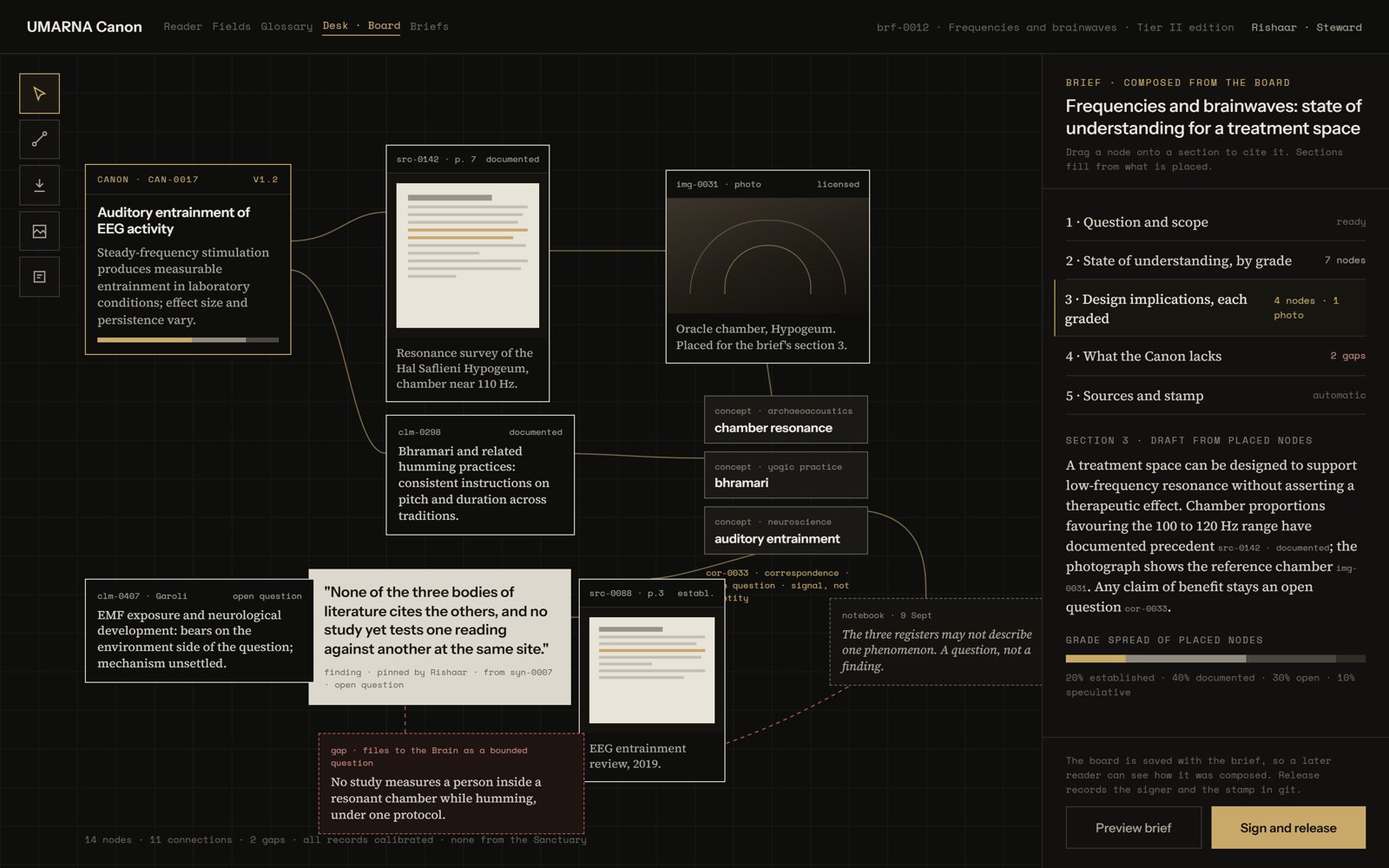
The Body
Asked and answered
At the Body, a question is put across the Core and answered by grade, with the gaps named honestly. Where the Body finds a gap, it returns to the Brain as a new question through the same gates, so every consultation leaves the research system with more to do.
-
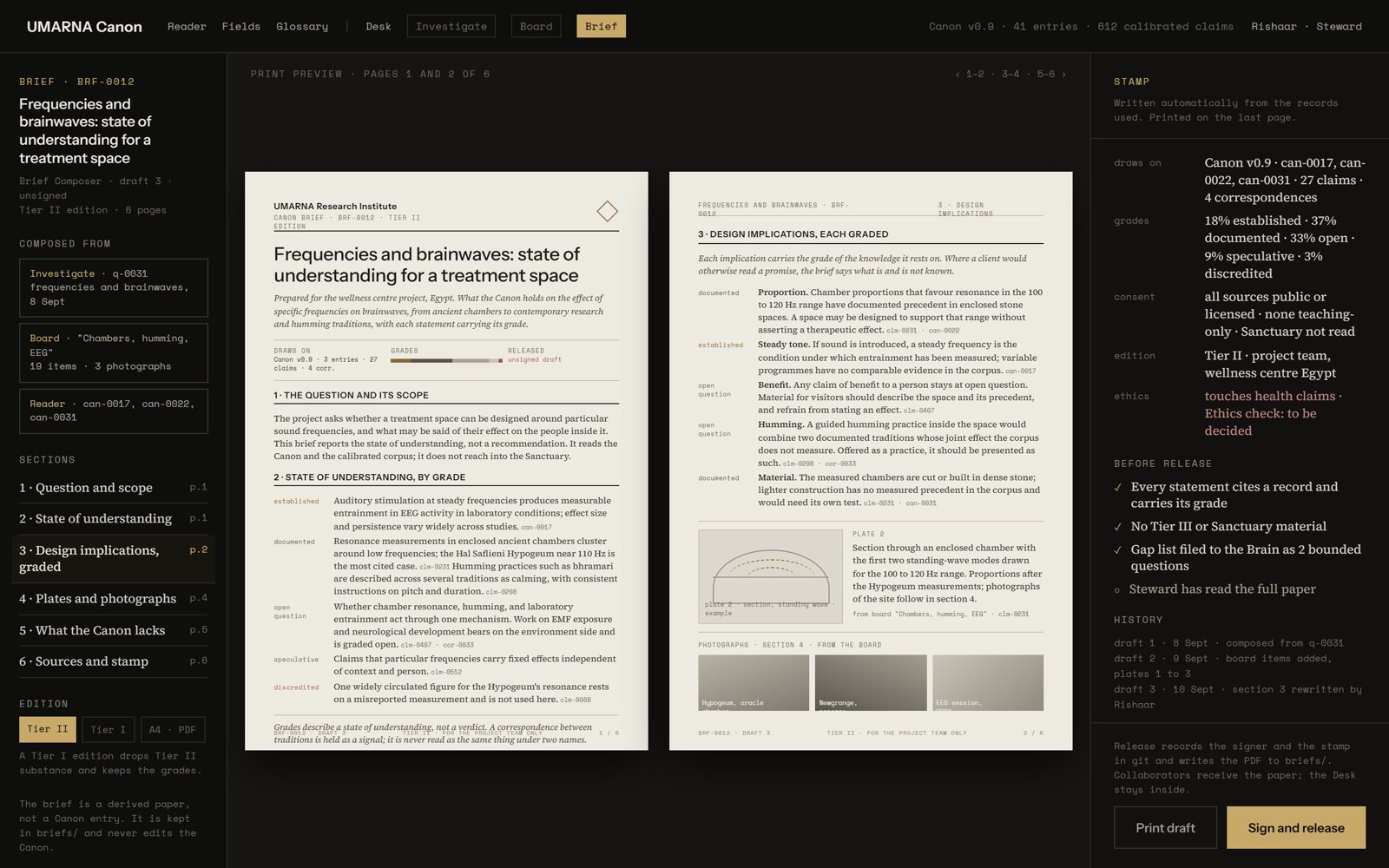
The Body
Composed and signed
A brief is composed for a real need, a project, a protocol, an educational programme. Each implication carries the grade of the knowledge it rests on, what the Core lacks is stated before the sources, and the brief is released only under a steward's signature.