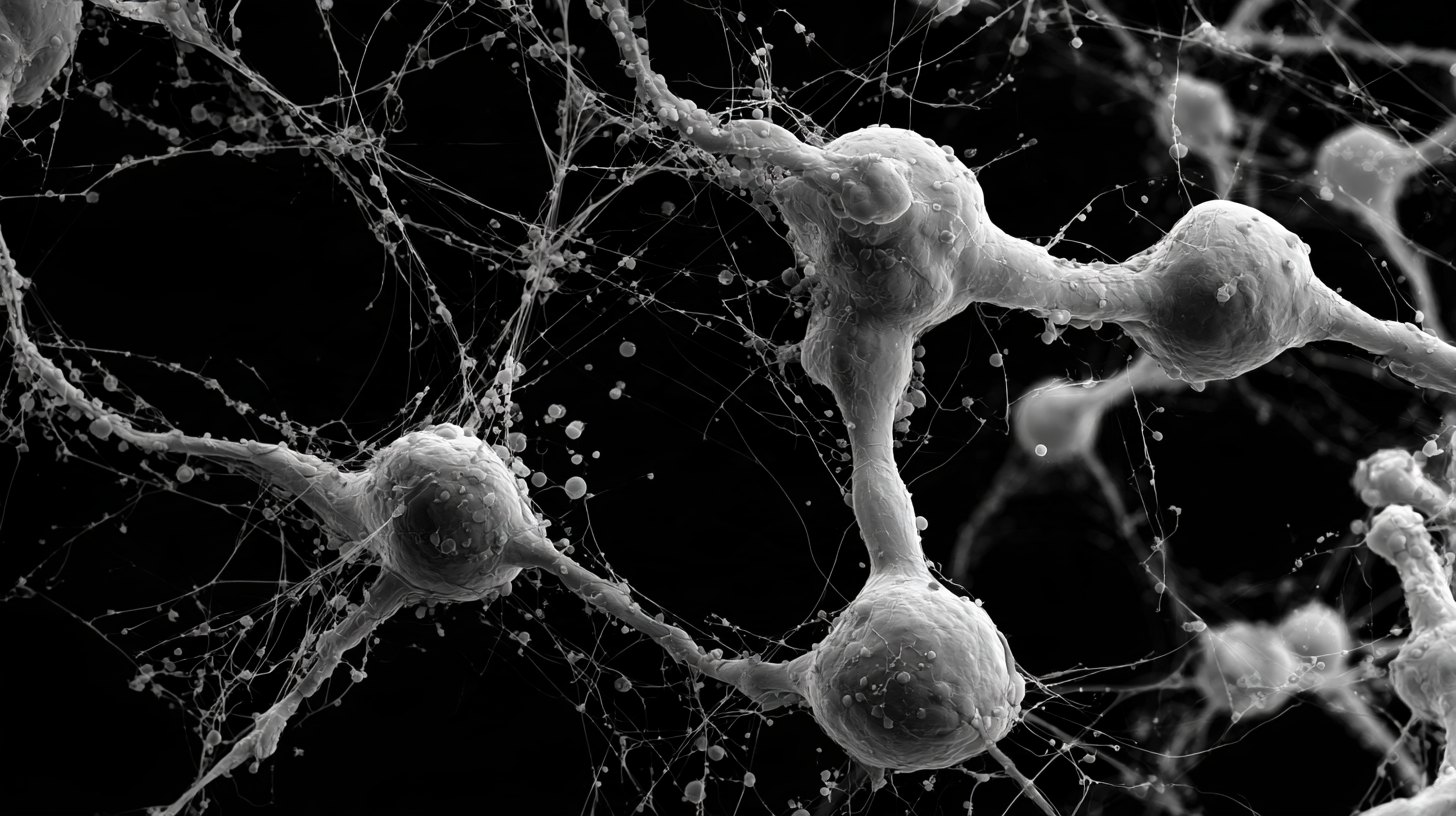
The Nervous System
UMARNA’s Nervous System is the connective intelligence of a larger human body, where thinkers, cultures, works, discoveries and questions become nodes within an evolving field of collective intelligence.
Like cells, organs and neural networks
Its parts remain differentiated while participating in a greater system.
A liver cell does not compete with a brain cell: each develops according to its own nature while contributing to the viability of the whole. The same principle can be observed in ecosystems, where diversity, communication, exchange and homeostatic balance allow distinct forms of life to coexist without one needing to prevail.
This is one of UMARNA’s points of departure: to study how nature organises complexity, communicates information, differentiates functions, regenerates and maintains coherence, and to investigate what these mechanisms might reveal for human systems.
Mathematics, biology, computation, algorithms, design, programming, physics, astrophysics and metaphysics can meet here to model, translate or emulate principles of natural organisation in response to social and cultural challenges. The aim is to develop forms of collective intelligence in which each culture, species, discipline and form of knowledge can grow through its own particular intelligence while contributing to a more coherent planetary whole.
The Great Mind is the evolving corpus
The network holds both individual intelligence and collective memory.
A thinker, researcher or inventor may become a node; a book, artefact, dataset, experiment or observation can carry information between nodes; a cultural tradition can function as a larger body of accumulated knowledge. The Nervous System is what allows information to move through it, so that a discovery in one field can activate a question somewhere else, a forgotten source can reopen an investigation, or a new finding can change an existing map.
A connection does not establish equivalence; it creates a reason to look more closely.
Sources are mapped, cross-referenced and enriched as new contributions enter the system. Computational tools and distributed AI can help trace relationships, compare large bodies of information and reveal patterns, while interpretation remains accountable to context, provenance and human judgment. The system remains deliberately unfinished. It can hold agreement, contradiction, uncertainty and absence; a missing name can reveal a missing connection, a dataset can challenge an assumption, and an unresolved question can become more valuable than a premature answer. UMARNA is interested in the possibility that one of the most important capacities of an intellectual organism is its ability to generate better questions as its understanding grows.
Nodes · Thinkers and artists
Names the institute thinks with, not names it agrees with.
- Pythagoras
- Heraclitus
- Plato
- Aristotle
- Hippocrates
- Archimedes
- Hypatia
- Plotinus
- Ibn al-Haytham
- Leonardo da Vinci
- Giordano Bruno
- Galileo Galilei
- Johannes Kepler
- Isaac Newton
- Baruch Spinoza
- Gottfried Wilhelm Leibniz
- Goethe
- Friedrich Nietzsche
- Michael Faraday
- James Clerk Maxwell
- Nikola Tesla
- Albert Einstein
- Max Planck
- Alan Turing
- Kurt Gödel
- Georg Cantor
- John von Neumann
- Oskar Morgenstern
- John Nash
- John Conway
- Ilya Prigogine
- Humberto Maturana
- Francisco Varela
- Gregory Bateson
- David Bohm
- Jacobo Grinberg
- Fritjof Capra
- Basarab Nicolescu
- Edgar Morin
- Buckminster Fuller
- Janine Benyus
- John T. Lyle
- Carl Jung
- Joseph Campbell
- Claude Lévi-Strauss
- Umberto Eco
- Michel Foucault
- Jorge Luis Borges
- Jean Baudrillard
- Rudolf Steiner
- Hilma af Klint
- George Gurdjieff
- Viktor Schauberger
- Wilhelm Reich
- Walter Russell
- Jacque Fresco
- Stanislav Grof
Questions we love · Points of departure
UMARNA begins with questions capable of opening territory.
Some may eventually become hypotheses, experiments, field studies or models; others may remain open for years. The value of a question is not always that it can be closed, but that it changes what can be seen.
Living systems & emergence
What allows a living system to organise, communicate, adapt, regenerate and persist?
How does intelligence emerge from networks of interacting parts?
Can collective intelligence exist without a central decision-maker?
What happens when a system becomes capable of observing, sensing and modifying itself?
What can self-organising systems teach us about institutions, technologies and societies?
Origins & fundamental principles
What physical conditions made the emergence of life possible?
Which principles govern the transition from matter to organised, self-maintaining systems?
How do simple interactions produce increasingly complex behaviour?
Are there principles that recur across physical, biological and informational systems?
What do particles, fields and collective phenomena reveal about the organisation of matter?
Fields, energy & measurement
What kinds of structures can actually be measured across physical systems and scales?
Where do apparently similar descriptions of fields correspond to the same measurable phenomenon, and where do they diverge?
What can precision measurement reveal about phenomena described by older traditions in different conceptual languages?
Quantum reality & cosmology
What would a coherent description of reality require beyond the current separation between quantum mechanics and gravitation?
What does the holographic principle actually establish, and where does interpretation begin?
What, if anything, does string theory predict that can be experimentally tested?
Why does time appear to have a direction?
What changes when the observer becomes part of the system being observed?
Consciousness & perception
What can first-person experience contribute to the scientific study of consciousness?
Which changes in perception correspond to measurable changes in neural or physiological activity?
How do breath, sound, attention and environment affect perception in real time?
Could consciousness be understood in relation to the wider social and ecological systems in which it develops?
Ancient systems & lost knowledge
What can ancient observations reveal when examined through contemporary instruments?
What technical knowledge can be recovered from ancient structures without projecting present assumptions onto the past?
How should a site be studied when geometry, acoustics, astronomy, ritual, material technology and social function may have operated together?
What did pre-modern chemistry contribute to the emergence of experimental knowledge?
What disappears when languages, libraries, institutions, technologies or communities are lost?
How can knowledge carried by living cultures be studied while respecting the conditions under which it is transmitted?
Civilisation & the future
What forms of civilisation can remain viable across centuries and millennia?
Which institutions can survive their founders?
How should education, governance, economies, settlements and technology interact if civilisation is understood as one interdependent system?
What deserves preservation?
What should remain adaptable?
What should future generations inherit from us — and in what condition?
These questions continually return to one deeper problem: how can intelligence become increasingly connected without becoming uniform; how can differentiated parts become more capable together; and what kinds of systems allow diversity itself to become a source of coherence, resilience and possibility?